
"Future-ready" is showing up everywhere in registry circles this year - it's the theme of November's Corporate Registers Forum conference in Singapore, and it's in nearly every registrar's strategy deck we've seen recently. That's a good thing; it means the conversation has moved past "should we modernise" to "what should we be modernising toward." But it also means the term is at risk of becoming a slogan rather than a standard and used to describe everything from a new online portal to a full legislative overhaul.
So, it's worth being specific. What does future-ready actually require of a registry, beyond the phrase itself?
It's not a technology state, it's an operating model
The most common mistake is treating "future-ready" as a technology milestone: cloud migration done, API layer built, legacy system retired. Those are useful steps, but they describe infrastructure, not readiness.
As registries become increasingly central to digital economies, future readiness is no longer about modernising an IT system. It is about ensuring that critical national infrastructure can continue supporting governments, businesses and citizens as expectations evolve.
A registry is future-ready when its Target Operating Model, not just its tech stack, is built to absorb change without a redesign every time something shifts. That means:
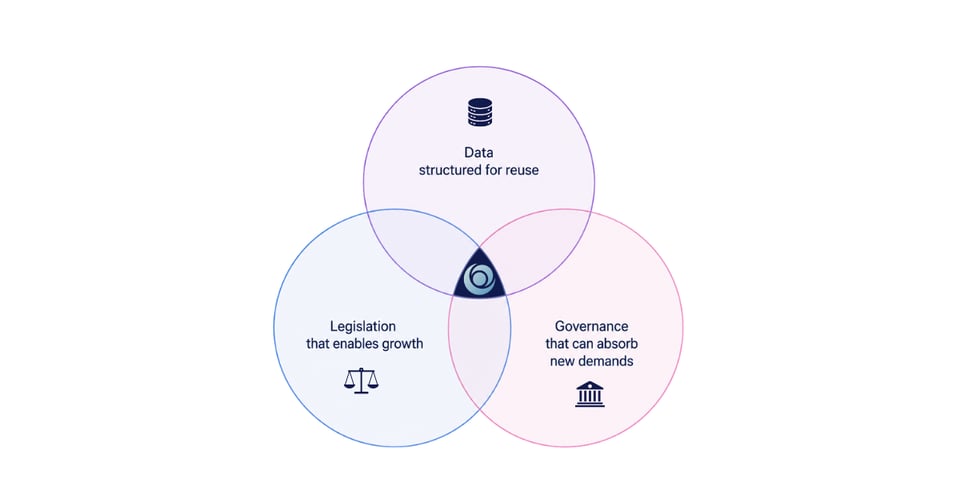
- Data structured for reuse, not just storage. Other agencies, regulators, and market participants should be able to consume register data directly and reliably, rather than each rebuilding their own version of the same information.
- Legislation that enables the model, rather than constrains it after the fact. A future-ready registry has already asked whether its legislative basis supports interoperability, data-sharing, and the roles it wants to play tomorrow, not just the roles it plays today.
- Governance that can absorb new demands. New use cases: beneficial ownership transparency, tokenised assets, cross-border corporate migration will keep arriving. A future-ready registry has a governance model flexible enough to take these on without a multi-year re-platform each time.
None of that shows up on a technology roadmap slide. All of it shows up in a Target Operating Model.
Three signals a registry is future-ready
If "future-ready" is more than a slogan, it should be observable. Three signals we look for:
1. The registry knows its own maturity, dimension by dimension. Not "we've digitised most services," but a clear, current picture across People, Process, Technology, Legislation, Stakeholders, and Data Governance, the six dimensions in the Registry Capability Maturity Model® (RCMM®). Registries that can name their own gaps precisely are almost always further along than those that describe themselves only in aspirational terms.
2. The registry can explain its value beyond its own budget line. A future-ready registry can articulate ideally with some quantitative rigor the value it creates for banks, lenders, corporate service providers, regulators, and the wider economy that relies on it being accurate and trustworthy. That's a harder exercise than a standard cost-benefit case, and it's one we've been building dedicated valuation methodology around specifically because quantifying the broader economic value of a register remains a challenge for many registries.
3. New requirements get absorbed, not bolted on. When a new obligation lands: a beneficial ownership register, a tokenization framework, a cross-border migration standard - a future-ready registry treats it as an extension of an existing operating model, not a one-off project bolted onto legacy infrastructure. If every new mandate requires a fresh transformation program from scratch, the registry isn't future-ready yet, regardless of how modern its portal looks.
.png?width=1536&height=1024&name=Future%20Ready%20Registry%20(1).png)
Why this distinction matters going into Singapore
The themes on this year's CRF agenda: beneficial ownership transparency, tokenization of shares, corporate migrations, and insolvency processes without liquidators are all, in effect, tests of future-readiness. Each one asks a registry to absorb a materially new function. A registry with a genuinely future-ready operating model can take these on as extensions of what it already does well. One that's only future-looking on the surface will find each of these a fresh transformation project.
That's the frame we'll be bringing to conversations in Singapore this November: not "how modern does your registry look," but "how much new demand can your current operating model actually absorb without breaking."
Future-ready registries are not those with the newest technology. They are those that can continue adapting as legislation, markets and public expectations evolve. Technology enables that capability, but operating model, governance and strategy determine whether it lasts.
Foster Moore's Registry Advisory practice is led by Bill Clarke, together with Justin Hygate and John Murray. If you're benchmarking your own registry against that question, we'd welcome the conversation, get in touch with the Registry Advisory team.
.png?width=653&height=224&name=Registry%20Advisory%20Banner%20(1).png)