
Some careers follow a carefully mapped-out path. Gyula Farkas' career has been more about curiosity, taking opportunities when they appear, and continuing to learn.
With a background in both software engineering and economics, Gyula brings an unusual combination of deep technical knowledge and a strong understanding of the wider business environment. Over his years with Foster Moore, he has worked across product development, projects, support and customer-facing roles, giving him the ability to look at registry challenges from several different angles. He understands what technology can do, but equally importantly, he understands that the best technical solution is not always the right solution for a customer.
His journey has also taken him from Hungary to New Zealand and eventually to Canada, where what was originally meant to be a two-year assignment became a much bigger chapter of his life and career. Today, that combination of technical expertise, registry knowledge and direct customer experience makes Gyula an important part of how Foster Moore helps registry organisations turn complex requirements into practical solutions.
We sat down with Gyula to talk about how it all happened.
What did you study, and did you always know you wanted to work in technology?
I did two degrees. I finished as a software engineer, and then I did a master's in economics as well, pretty much one after the other.
When I was a little kid, I always said I was going to be an engineer. I did not know what kind of engineer, but by the time I got to the point of studying, computers and software engineering were the thing, so I went for that.
I like the troubleshooting, the problem solving and thinking about complex issues. The economics came on top of that and showed me a different kind of thinking and a different view of business. It was a good eye-opener. It is not just about the problem and what you are doing with it, but how the whole thing fits into the wider economy.
What was your first experience working with government technology?
One of the jobs I had back in Hungary showed me the government side of things. I worked on the Hungarian government portal, including a single sign-on that everyday users could use to interact with government.
That was really new at the time. It was also the first time I saw how much security you need in a government environment compared with the open market. It was a very interesting introduction to how this kind of space works.
How did you end up in the registry industry and at Foster Moore?
It was by chance. The company I was working for had connections with people on the original Foster Moore team, and they told me they were looking for people and asked if I would be interested.I said, "I don't know what it is, so let's have a look."
What I liked was that I knew a couple of people there who I thought were really strong technically and in how they did business in New Zealand. I thought, okay, this sounds like a good place to go because I am going to learn a lot. And it did not disappoint.
What did those early years at Foster Moore look like?
Back then it was all Java developers. I started as a developer and did some enhancement work on one of the existing systems. Very quickly I moved into the new platform, where I joined the team developing things like the security and payment modules.
Since then, I have been around this space in different roles, whether on the product side, project side or support side. I have sat in pretty much every place.
It was not just about climbing the ladder. Doing product development and then experiencing support showed me the other side. You see how something you built as a developer is actually being used by the client, and what they think is important compared with what we think is important.
Why has that customer-facing experience been so important?
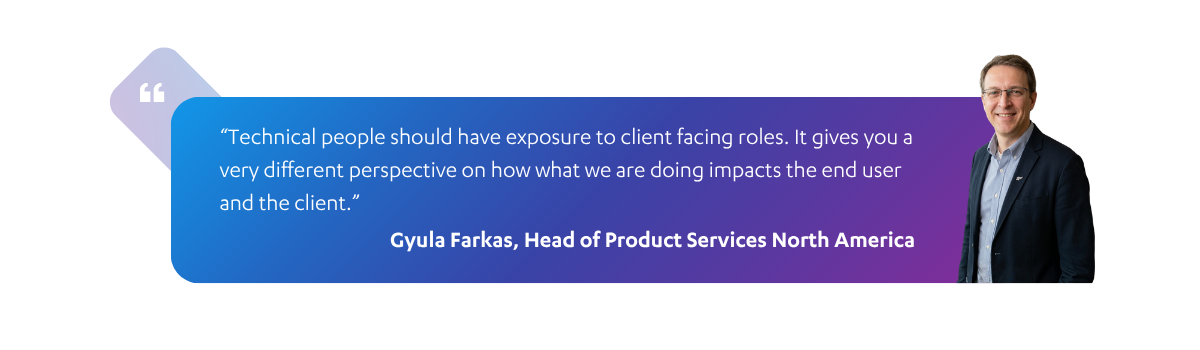
To be honest, I think most technical people should have some exposure to the client or experience in a client-facing role, even if it is only temporarily for a few months or half a year.
It gives you a very different perspective on how what we are doing impacts the end user and the client. It makes it real. You see the result of what you built six months or a year ago, how it is being used and what it actually means to them.
Is there a customer project that particularly changed your perspective?
There was a project in Ontario that was very interesting and stretched us as a company and me personally. The customer was using functionality in the system differently and to an extent that other clients had not. That meant they found issues, asked questions and needed things we had not dealt with before.
For me, it was also a very client-facing role. We were actually sitting in the client's office at the time, so we were available pretty much five days a week. They could just walk over, ask a question or make a request. It was very different from working on the product or projects from the back end. That is where you really see how what you have built impacts the client and their users.
How do you balance what customers want with what makes sense for the product?
The interesting thing is that customers themselves can be of two minds. On one side, every customer wants to have a say in what happens to the product, what features they want and what functionality they would like. On the other hand, they also want us to be the registry people, the experts who can tell them what the future looks like and what is coming.
When you are dealing with one client, you learn their business and start seeing where they are struggling. One thing we have done is talk to staff individually and ask them what is painful. Then you start seeing patterns. If multiple people are facing the same challenge, that tells you something, and you may be able to help them in a way that them alone wouldn’t be able to.
Across different customers, you do the same thing. You look for common patterns. That helps you understand where you really need to focus.
How does working across different jurisdictions make you better at solving those problems?
When you work on the technology side, you are always looking at what new things you can do. When you move closer to clients, you start seeing other things: what is important to them, what restrictions they have and how risk averse they are.
You learn to look at the system through their lens. Yes, technically we could do a lot of things, but which option is the most stable? Which is the safest? That is a different point of view that you need to learn.
You also see customers increasingly looking at other jurisdictions for examples and best practise. They might see something another registry is doing and ask whether they could do something similar. That is where having experience across the registry world becomes useful. You can understand the patterns, but you still have to work out what makes sense for that particular customer and understand their context and limitations.
How did the move from New Zealand to Canada happen?
Around the time I started, Foster Moore won the Ontario Business Registry project. The original team came over to do the assessments, architecture and initial work, and after a couple of years people started moving back to New Zealand. There was a need to have people here to replace that first crew.
I said, "I haven't been to Canada. I would be interested in going."
In my mind it was temporary. I was going to come up for a couple of years and have fun here. I always say I signed up for two years. That was June 2014, so it has been quite a bit longer than two years now. The job was interesting. The work was interesting. The roles I was doing were interesting. So we kept going.
What technology is exciting you most in the registry space right now?
You have got to say AI; it actually is exciting.Right now everybody is trying to figure out how to use it. It is a new shiny tool, but nobody really knows yet what it is good for and what it is not good for.
I look at it from two points of view. Internally, how do we incorporate it into our work? How can it help us be better, faster or more automated? But the other side is how we make this technology useful to our clients.
That is where you have to start with the real pain point. We have seen new technologies before where everybody wanted to use them, but there was not necessarily a use case where they made sense. With AI, we are starting to see areas where it genuinely could help, such as name reservation or fraud detection. Then the question becomes how you do that in a way that is acceptable to the client.
Does the wider impact of AI concern you as well as excite you?
Absolutely. One of the AI courses I did looked at the human side of it. If AI makes a decision and that decision is wrong, who is responsible? Is it the owner? Is it the developer? Is it the product manager who decided how it should work?
That is a very interesting topic. It is not only about what the technology can do. You also have to think about how it fits with legislation, responsibility and the wider environment around it.
What do you enjoy outside of work?
I am still really interested in science. If I have half an hour in the evening, I will probably watch something about physics or science. The science has progressed so much that there is always something new to learn.
And I love travelling. I have a wooden map on the wall and put a pin everywhere I have been. When I was living in New Zealand, because New Zealand is far from everywhere, I would collect my holidays and then take a month off and just go explore. A week here, a week there. Those were some of the best holidays I have had. You just explore and learn new things.
After all these years, what makes Foster Moore special to you?
Someone once told me that people come because they need work, but they stay for the people. I think that is very true.
Somehow we have managed to put together a really cool bunch of people who are genuinely good to work with. It is enjoyable. You build personal connections, you get inspiration from people, sometimes there is a bit of competition, and that keeps you going.
For me, that is probably the thing that motivates me most. There is a good bunch of talented and caring people here, and it is very cool to work with them.
From software developer to trusted registry expert
Gyula's story reflects something that is easy to say but much harder to build: genuine expertise comes from seeing a problem from more than one side. He has written the code, worked on the product, supported live systems, sat alongside customers, listened to their frustrations and helped translate those needs back into practical technology decisions. His software engineering background gives him the depth to understand what is technically possible, while his economics background and years of customer experience give him the perspective to ask the equally important question: does it make sense?
His move from New Zealand to Canada has added another layer to that experience. What began as a two-year assignment has grown into more than a decade of working alongside customers and helping strengthen Foster Moore's presence in the region. The expertise Gyula brings, combined with the relationships and experience across our team in North America and Caribbean, is something we are incredibly proud of. They represent Foster Moore at its best: technically strong, curious, pragmatic, close to our customers and always willing to learn.
--

Gyula Farkas is a senior technical leader at Foster Moore, bringing together deep software engineering expertise, business insight, and extensive experience working directly with registry customers. Having worked across product development, projects, support, and customer-facing roles, Gyula has a unique ability to connect what technology can do with what registries actually need. Now based in Canada after beginning his Foster Moore journey in New Zealand, he plays an important role in helping customers navigate complex technical challenges, identify practical opportunities for innovation, and build registry solutions that deliver real value.
Subscribe to our newsletter to read more Registry People profiles and expert perspectives from across the global registry community.