
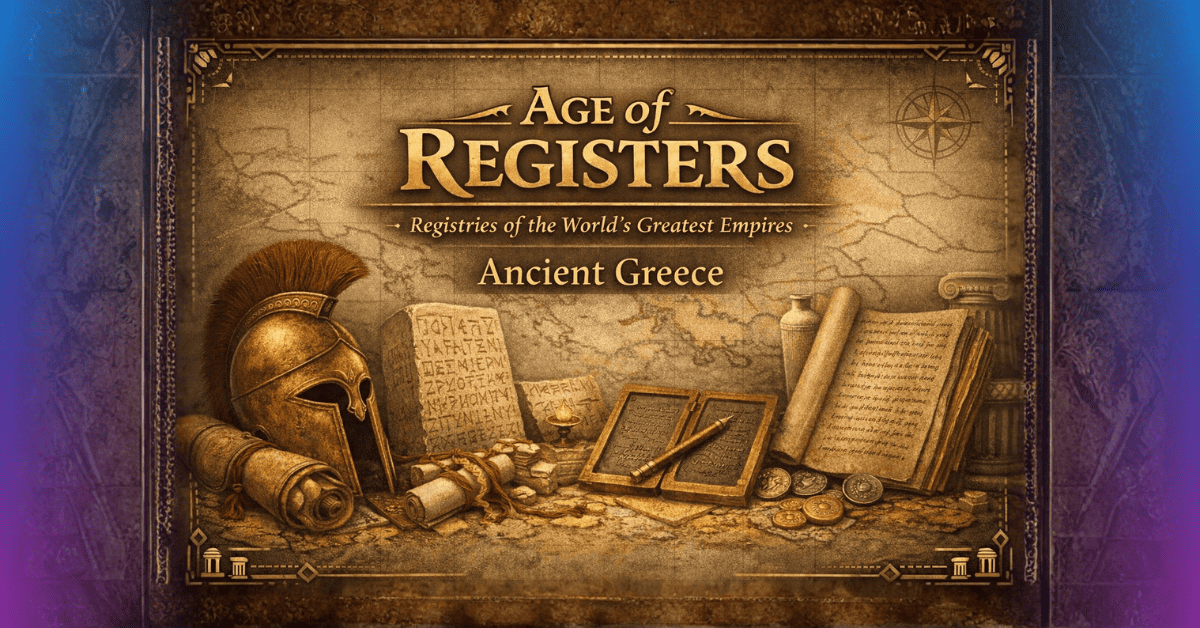
If Ancient Egypt teaches us that registers are born from taxation and control, Ancient Greece reveals something more subtle and arguably more transformative: registers evolve when commerce becomes public.
Between roughly 800 and 323 BCE, the Greek world shifted from palace economies and agrarian administration to something recognisably modern, trade conducted across cities, islands, and seas. With this expansion came a new reality: strangers trading with strangers, capital crossing borders, ships arriving from distant ports, and goods changing hands in public marketplaces.
And with that reality came a new need. Not simply to count, but to account.
A World of Markets
The Greek polis was not an empire but a network of fiercely independent city-states. Athens, Corinth, Miletus, Rhodes, each operated as a sovereign jurisdiction with its own laws, currency, magistrates, and economic interests.
At the center of the polis, the agora or central marketplace, was not merely a place of exchange, it was the center of all social life. Trade was permitted, supervised, taxed, and recorded. Maritime commerce connected the Aegean Sea to Egypt, the Mediterranean, and the Black Sea. Grain, olive oil, wine, silver, timber, and slaves flowed across these routes.
Unlike Egypt’s centralised administration, Greece’s economy depended on trust between non-kin actors. That trust had to be engineered. And so the Greeks began to formalise visibility in commerce.
It is easy to romanticise Greece as the birthplace of philosophy and democracy. Less often do we recognise it as a laboratory for commercial governance.
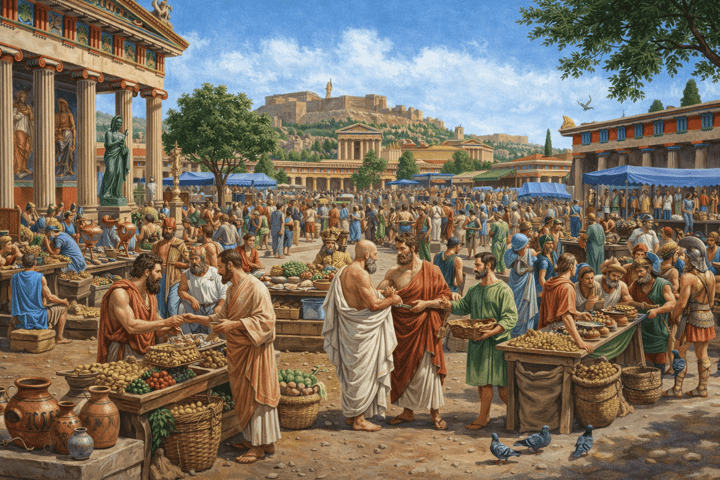 Bustling agora of ancient Athens - Image create using generative AI
Tools, Officials, and Methods
Greek record-keeping did not rely on a single central bureaucracy. Instead, it was embedded within civic institutions.
Magistrates such as the agoranomoi (market overseers) and epimeletai (supervisors) regulated trade, inspected goods, enforced weights and measures, and ensured compliance with market rules. Maritime trade was overseen by port officials who tracked ship arrivals, cargo declarations, and applicable duties. Their existence is documented both in literary sources, including Aristotle’s Politics, and in inscribed decrees that define their authority and responsibilities.
Records were maintained on wooden tablets and papyrus for day-to-day administration, though these materials rarely survive in the Greek climate. What endures most visibly are stone inscriptions. Public decrees, tax obligations, commercial privileges, maritime regulations, and temple financial accounts were engraved in stone and displayed in sanctuaries or public buildings. Numerous examples, now housed in the Epigraphical Museum in Athens and the British Museum, demonstrate that these inscriptions recorded financial figures, names of officials, contractual terms, and regulatory requirements with striking specificity.
The choice of stone was deliberate. It signaled permanence. It signaled authority. It signaled public accountability. By placing fiscal accounts and commercial privileges in public view, the polis transformed documentation into a civic act.
For a registry professional, this is a critical inflection point: the evidentiary durability of the record becomes inseparable from its legal force.
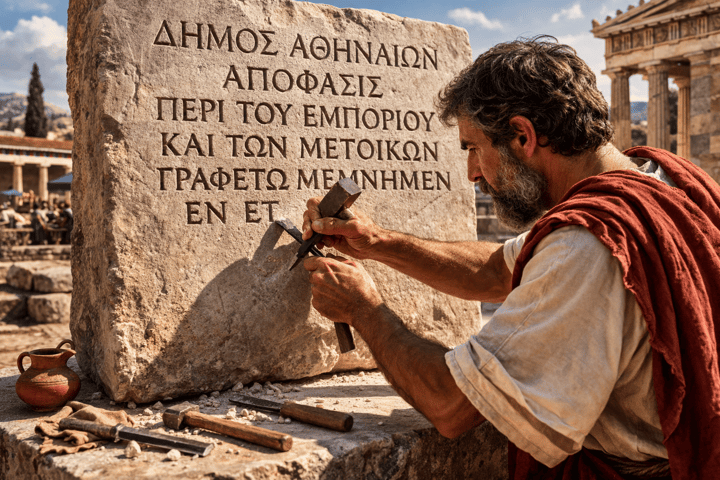 Scribe working on public decree - Image create using generative AI
Key Registry Types in Ancient Greece
The registry systems of Ancient Greece were not housed in a single central archive, nor compiled into bound volumes as we would expect today. Instead, they were distributed across ports, marketplaces, temples, and civic buildings, embedded within the institutional fabric of the polis. What survives in stone inscriptions, papyri, and literary references reveals a set of recognisable registry functions: maritime documentation, market licensing, foreign trader registration, tax records, and publicly displayed legal and financial accounts. Together, these records formed a structured framework of commercial visibility. They demonstrate that participation in Greek economic life required recognition, documentation, and, in many cases, public declaration.
Below are the principal registry types evidenced in the archaeological and literary record.
Merchant and Ship Registers
Maritime trade was the lifeblood of many Greek city-states, especially Athens. Evidence from inscriptions and surviving financial accounts suggests systematic documentation of ships, cargo, and customs dues.
In classical Athens, foreign merchants, known as metics, were required to register their residence and often their commercial activity. Ships entering Piraeus, the Athenian port, were subject to customs duties (such as the pentekoste, a 2 percent tax on imports and exports). Collection of this tax required records of cargo origin, ownership, and declared value.
While we do not possess bound volumes titled “Ship Register,” we do have fragments of port tax inscriptions, customs farming contracts, and maritime loan agreements that demonstrate structured oversight.
The logic is clear: where capital moves, it must be recorded.
Licensing of Markets and Ports
Markets were not open arenas of unregulated exchange. They were licensed spaces.
Certain goods required permission to trade. Grain imports, especially during shortages, were subject to strict supervision. Athens even enacted laws preventing the export of locally produced grain during crises. Enforcement required monitoring, and monitoring required documentation.
Ports functioned similarly. The right to trade, to dock, to unload cargo, and to sell goods within city limits was embedded in legal frameworks. Decrees granting trading privileges to foreign cities were publicly inscribed, creating a visible and durable record of commercial rights.
In effect, commercial participation was conditional upon recognition by the state.
This is proto-licensing.
Taxation of Non-Citizen Traders
One of the most telling features of Greek commercial governance is the taxation of metics and foreign traders. Non-citizens paid special taxes for the right to reside and conduct business. They were required to register under citizen sponsors and were legally identifiable within the civic framework.
This is a sophisticated regulatory concept.
Commerce was encouraged, but not anonymous. Economic participation required disclosure and status recognition. The city-state balanced openness with control.
For modern registry professionals, this mirrors contemporary debates around beneficial ownership, cross-border activity, and economic transparency. Greece shows that openness and oversight have long coexisted.
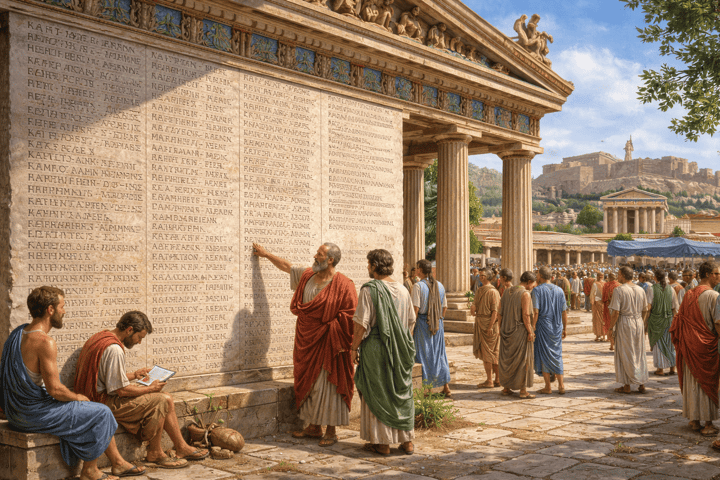 Ancient Athens Citizens study inscriptions - Image create using generative AI
Public Inscriptions as Legal Records
Perhaps the most striking registry foundation in Ancient Greece is the use of public inscriptions as enforceable legal records. Financial accounts of temple treasuries were engraved and displayed in sanctuaries. Treaties outlining trade privileges were inscribed for all to see. Lists of debtors, tax farmers, magistrates, and public contractors appeared on stone stelae erected in civic spaces.
These were not internal ledgers kept behind administrative walls. They were civic declarations placed deliberately in the public domain. In doing so, the Greeks institutionalised a form of visible governance that made economic rights and obligations subject to collective scrutiny.
The act of public inscription created legitimacy. It reduced informational asymmetry. It allowed disputes to be resolved by reference to a shared and durable record.
Transparency was not merely administrative. It was architectural, embedded in stone, and foundational to the functioning of the polis.
The Registry Shift - From Centralisation to Coordination
In Egypt, registers were instruments of central command, designed to measure land, mobilise labour, and sustain the authority of the state. In Greece, something more fluid began to emerge. Governance was no longer concentrated solely in palace or temple administrations. It was distributed across citizens, traders, magistrates, shipowners, lenders, and foreign residents. Economic life became mobile, competitive, and increasingly international. Goods crossed seas. Capital followed opportunity. Agreements bound strangers together.
This shift altered not only how economies functioned, but how they were governed. Registration moved from being a tool of extraction to a tool of coordination. The polis did not merely count resources; it recognised participants. It documented rights, declared privileges, enforced obligations, and made commercial status visible within a civic framework.
As markets expanded, so too did the need for structured oversight. Exchange between autonomous actors required common reference points. Contracts needed enforceability. Taxes required declaration. Privileges required inscription. Commerce created complexity, and complexity demanded public visibility. Visibility, in turn, required records that could endure, be consulted, and be trusted.
In Greece, we witness a decisive evolution: the registry becomes not just a mechanism of control, but an infrastructure of accountability within a growing commercial society.
Key Lesson: Commerce Creates Public Accountability
The legacy of Ancient Greece lies not in a single surviving ledger, but in the principles it embedded into commercial life. By publicly inscribing trade privileges, recording maritime loans, registering foreign merchants, and subjecting markets to civic oversight, the Greeks advanced an idea that still shapes registries today: economic participation must be visible to be legitimate.
They transformed record-keeping from a tool of state extraction into a shared framework that enabled broader participation in commerce. Registration was no longer only about measuring resources for the state. It became a mechanism for recognising actors within the market itself.
In doing so, the Greeks helped democratise trade. Non-aristocratic citizens, resident foreigners, and maritime entrepreneurs could operate within recognised legal structures, provided they were documented and accountable. Visibility became the price of participation.
The registers of the polis did not simply control markets. They stabilised them, widened access to them, and embedded accountability into public life. In that sense, every modern business registry still carries something distinctly Greek: the conviction that transparency is not the enemy of commerce, but its foundation.
Next: The Roman Empire, where law gives corporate personality a name.